Mulch calculator Settled depth
Plan from the finished layer
Mulch Settlement Calculator
Choose the depth you want to remain, then enter a loss percentage from your product, supplier, or own measured comparison. This page does not assume one rate for every mulch.
How the calculation works
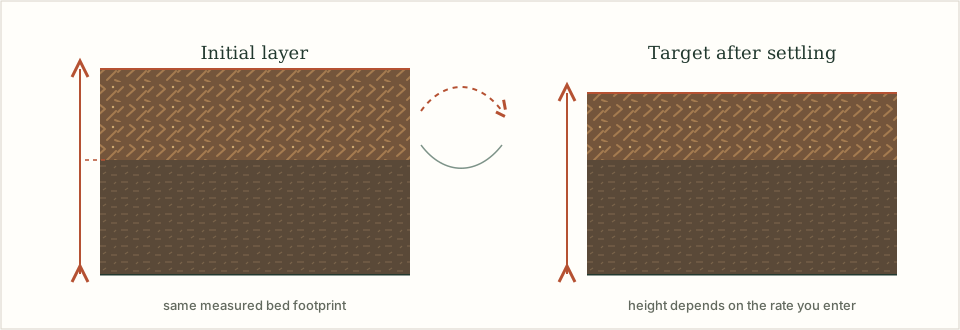
The tool treats the loss percentage as a share of the initial layer depth. If you expect to lose 10% of that starting depth, 90% remains in the model.
Volume in cubic feet = area in square feet × initial depth in inches ÷ 12
Whole bags = cubic feet ÷ labeled bag volume, rounded up
For the example above, 3 in ÷ 0.90 = 3.33 in to start. Across 100 sq ft, that is 27.78 cu ft, or 1.03 cu yd. With a 2 cu ft bag label, the order rounds up to 14 bags. Each result follows from the entered assumptions.
Iowa State University Extension uses measured bed area multiplied by mulch depth in feet to calculate volume, then converts cubic feet to bags or cubic yards. This calculator applies that relationship after solving for your initial depth. See Iowa State’s mulch quantity guide.
Why the rate stays in your hands
Mulch materials did not settle at one shared rate in a University of Florida field comparison. The study began with a 9 cm layer and measured six materials in an open field near Gainesville. After two years, the reported average remaining depths differed:
| Material in the study | Average depth remaining after two years |
|---|---|
| Pine straw | About 1 cm of the original 9 cm |
| Utility-pruning blend and eucalyptus | About 5 cm |
| Pine-bark and cypress | About 6 cm |
| Melaleuca | Nearly 7 cm |
Those are observations from one Florida study setup, not a forecast for a different product, bed, climate, or time period. The University of Florida publication describes its test conditions and comparison. Use a rate that fits the exact material and job you are planning.
Settlement loss and order allowance are different inputs
This calculator solves for an initial depth when you specify how much of that depth may be lost. The mulch project planner adds an editable ordering cushion to measured volume. That cushion is not a measured settlement rate.
If mulch is already in the bed, measure the layer that remains. The mulch top-up calculator compares that measurement with a target depth; it does not need a forecast percentage.
Mulch settlement questions
What does the settlement percentage represent?
It is the share of the initial layer depth that you expect to lose. The calculator divides your target settled depth by the remaining share, then estimates volume from the measured area.
Is 10% a standard mulch settlement rate?
No. This calculator has no preset rate. Use a value from the exact product, a supplier, or your own measured comparison. The cited University of Florida field study found different two-year depth changes among six materials under its test conditions.
Is this the same as the extra percentage in the mulch project planner?
No. This page treats the percentage as depth lost from the initial layer. The project planner applies a separate user-edited ordering cushion to measured volume. Do not combine them unless the two assumptions describe different needs.
Does the result recommend a suitable mulch depth?
No. It only applies the values you enter. Check plant, product, soil, slope, climate, and local guidance before choosing a depth to spread or maintain.