Mulch calculator / Playground surfacing
MEASURED AREA · SOURCE-LINKED DEPTHS
Playground Mulch & Loose-Fill Quantity Calculator
Use a CPSC Table 2 fallback row when it applies, or enter the exact installation and maintenance depths from your surfacing product documents. Then calculate from your measured area.
Public-playground planning reference. Each footprint helper applies only within its stated CPSC scope and after you check the current equipment documents. This page estimates quantities; it does not choose a material, validate a use zone, rate a product, or check safety or compliance.
YOUR MEASUREMENTS · YOUR PRODUCT LABEL
Estimate the fill order
Enter the full area from your plan. Choose a CPSC Table 2 row only for the materials and conditions it covers, or enter exact product-document depths.
Need the area from a rectangular equipment footprint?
This helper adds 6 ft to each side of one rectangular footprint. Use it only when the CPSC Handbook's general recommendation in §5.3.10 applies; listed equipment such as slides, swings, climbers, and composite structures has separate guidance. If you are unsure or the footprint is not rectangular, enter an area from the applicable equipment plan.
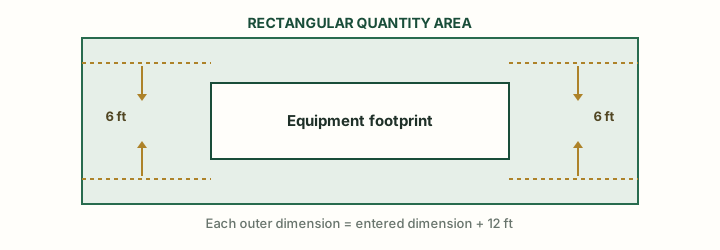
Enter both outer dimensions in feet.
Planning loose-fill area for one single-axis belt swing?
For a public-playground belt swing, the CPSC Handbook's Figure 25 shows a front and rear distance of 2 × H on each side of the pivot line, where H is the vertical distance from the pivot to the top of the protective surface. It also shows at least 6 ft to each side from the swing perimeter. Enter the measured side-to-side span between the swing's outer perimeters and your measured H. This estimates a rectangle for quantity planning only; check the current handbook and equipment documents yourself.
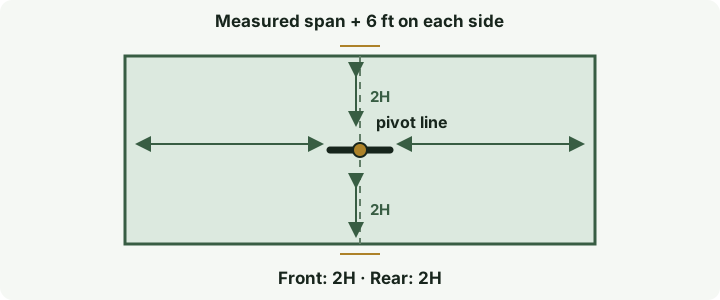
Enter the measured swing span and pivot-to-surfacing height in feet.
CALCULATED FROM YOUR INPUTS
Quantity estimate
Choose a material to see its listed depths.
Neither a depth-table value nor a depth you enter is a product test result. The calculation does not tell you whether a material or installed surface is suitable for the equipment.
SOURCE TABLE · PUBLIC PLAYGROUND GUIDANCE
CPSC Table 2 loose-fill references
The July 2025 handbook presents these fallback depths for non-impact-tested loose-fill materials when tested material data with a manufacturer-specified critical height are unavailable. EWF and other product-specific tested materials use their own current test and installation information; the figures below are not substitutes for those documents.
| Loose-fill material | Installed depth | Compressed depth | Listed critical height | Initial volume for your area |
|---|---|---|---|---|
| Rubber mulch | 8 in | 6 in | 10 ft | Enter area |
| Sand | 12 in | 9 in | 4 ft | Enter area |
| Pea gravel | 12 in | 9 in | 5 ft | Enter area |
| Wood mulch (non-CCA) | 12 in | 9 in | 7 ft | Enter area |
| Wood chips | 12 in | 9 in | 10 ft | Enter area |
The handbook notes that rubber loose-fill does not compress in the same way as other loose-fill material, though displacement can still occur. Conditions and maintenance can reduce a listed critical height. Read the source table and the current instructions for the exact product.
Read the CPSC Public Playground Safety Handbook · Publication 325, July 2025, §2.4.2.2 and Table 2.
CHECK THE ORDER MATH
Area × depth gives the volume
For a square-foot area and an inch depth, divide the product by 12 to get cubic feet. Divide cubic feet by 27 to get cubic yards.
- Initial fill: area (ft²) × installed depth (in) ÷ 12 = ft³.
- Product-specific fill: area × the exact product-document installation depth ÷ 12 = ft³. No depth preset or compaction allowance is added.
- Eligible rectangular footprint: (length + 12 ft) × (width + 12 ft) = area (ft²), adding 6 ft on each side under §5.3.10.
- Single-axis belt swing area: (measured side-to-side span + 12 ft) × (2H + 2H) = area (ft²), using Figure 25's 6-ft sides and front/rear dimensions; H is the measured pivot-to-surfacing height.
- Table comparison: area × compressed depth ÷ 12 = ft³ at the listed compressed depth.
- Quantity difference: area × the positive difference between the table depth and your measured current depth ÷ 12.
- Product-specific quantity difference: area × max(0, document minimum-maintained depth − measured current depth) ÷ 12.
- Whole bags: round up initial ft³ ÷ the package volume you enter.
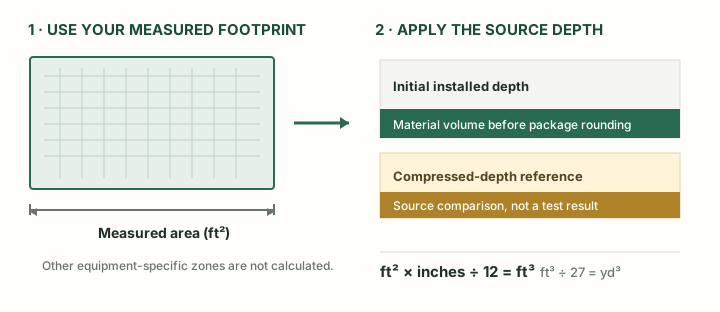
Worked example with chosen inputs
For 200 ft² and the wood-chips row, 12 in installed depth gives 200 × 12 ÷ 12 = 200 ft³, or 200 ÷ 27 = 7.41 yd³. At a label volume of 2 ft³ per bag, that is 100 bags before any supplier-specific order rule.
If the current average measured depth is 7 in, the difference to the table's 9 in compressed-depth reference is 200 × (9 − 7) ÷ 12 = 33.33 ft³. This is a volume difference, not a performance or safety finding.
Product-document example: If a selected product's current instructions list 9 in for initial installation and 6 in as its minimum maintained depth, a 200 ft² area takes 150 ft³ (5.56 yd³) for the initial fill. At 2 ft³ per bag, that is 75 bags. If the current measured depth is 4.5 in, the quantity difference to the entered 6 in target is 25 ft³, or 13 whole 2 ft³ bags. These are chosen example inputs, not EWF recommendations.
For one 10 ft × 8 ft rectangular footprint where the general §5.3.10 recommendation applies, the helper adds 6 ft to each side: 22 ft × 20 ft = 440 ft². At the listed 12 in wood-chip depth, that is 440 ft³, or 220 bags at 2 ft³ each before supplier-specific order rules.
For one single-axis belt swing with a 6 ft side-to-side span and an 8 ft pivot-to-surfacing height, the Figure 25 dimensions are 18 ft across (6 + 6 + 6) and 32 ft front-to-back (2 × 8 + 2 × 8): 576 ft². The helper can pass this area to the same quantity calculator after you confirm the scope.
KEEP THE REFERENCE IN SCOPE
What this calculator does not decide
- Product-specific data come first. CPSC says EWF surfacing should meet ASTM F2075 and be impact-tested to and comply with ASTM F1292. Its manufacturers should provide critical-height and minimum fill-depth data. Use the exact product documents; this calculator only multiplies depths you enter by your measured area.
- Use-zone geometry has a narrow scope. The rectangle helper estimates one footprint only after you confirm §5.3.10 applies. The swing helper is limited to one single-axis belt swing and Figure 25 dimensions. Neither handles overlapping areas, obstacles, multiple pieces, composite equipment, or site-plan adjustments.
- The table is not a pass/fail test. It does not compare equipment fall height with a product's tested critical-height rating, inspect the installation, or determine local requirements.
- Keep the use context in view. CPSC Publication 325 is the Public Playground Safety Handbook. For home play equipment, follow the equipment and surfacing manufacturer's current instructions; this page does not assess a residential installation.
COMMON QUESTIONS
Playground mulch calculator FAQ
How much playground mulch do I need?
Enter the full measured surfacing area, choose a CPSC Table 2 material row, and use its listed installed depth to estimate cubic feet and cubic yards. Enter the package volume from the product label if you also need a whole-bag count.
Does this calculator choose a safe depth?
No. It displays source-linked table values and calculates material quantity. Use the exact product's current impact-test and installation documents; this page does not decide whether a surface is suitable for equipment.
What does the compressed-depth value mean?
It is the compressed-depth figure listed beside the installed depth in CPSC Table 2. The handbook says loose-fill materials change with use and weather and need maintenance; this calculator does not inspect or certify the installed depth.
Can I estimate an equipment use-zone area?
The optional helper adds 6 ft to each side of one rectangular footprint only when the CPSC Handbook's general §5.3.10 recommendation applies to that equipment. The Handbook has separate guidance for listed types such as slides, swings, climbers, and composite structures. Check the current CPSC Public Playground Safety Handbook and the equipment instructions. The helper does not assess safety, overlap, obstacles, or compliance; for home equipment, follow its current manufacturer documents.
Can I estimate a single-axis belt-swing area?
The optional swing helper uses one measured side-to-side swing span and the pivot-to-surfacing height you enter: it adds 6 ft to both sides and 2 × H in front and behind, as shown in CPSC Figure 25. Use it only for one single-axis belt swing in a public-playground plan after checking the current CPSC handbook and equipment documents. It does not model overlap, obstacles, multiple swings, full-bucket or tire swings, or compliance. It estimates quantity area only.
How many bags should I buy?
Enter the package volume in cubic feet from the bag label. The calculator divides the estimated initial volume by that amount and rounds up to a whole bag. It does not assume a standard bag size.
Can I calculate EWF from the product's own documents?
Select the product-specific depth basis, enter the initial installation and minimum maintained depths from the exact product's current documents, and use your measured surfacing area. The calculator adds no default depth or compaction allowance and does not verify product testing, suitability, or compliance.
Is ordinary garden mulch interchangeable with playground surfacing?
This calculator cannot determine product suitability. Check the exact product's impact-test, installation, and maintenance information for the intended play use.
PRIMARY SOURCES
References and calculation basis
- U.S. Consumer Product Safety Commission, Public Playground Safety Handbook, Publication 325, July 2025 — §2.4.2.2 discusses EWF testing and manufacturer-provided depth data; Table 2 provides fallback references for non-impact-tested loose-fill; §5.3.8.2–§5.3.8.3.3 and Figure 25 describe single-axis swing dimensions; §5.3.10 covers equipment not specified elsewhere. Checked November 4, 2026.
- NIST Handbook 44 (2026), Appendix C — unit conversion reference: 27 cubic feet equal 1 cubic yard.